Sand Summit Fieldbook — Chapter 03: Alpine Ecology, Flora & Microclimates
Chapter 03 • Altitude Zonation & Botanical Clues

Finding life in exposed places

To the hurried walker, the ground above the birch forest looks like uniform brown heather and grey rock. Look down closely at boot level, however, and you will find an intricate mosaic where plants map winter snow drift thickness and underlying rock chemistry to the centimetre.

Vertical Belts

The Four Altitudinal Steps of the Norwegian Fells

Because Norway spans a vast latitudinal range and a strong oceanic-to-continental gradient, the treeline sits near 1,100 metres in inner Jotunheimen, drops to 600 metres on the windy west coast, and meets sea level in northern Finnmark. Ecologists divide the mountain profile into four readable belts.

Subalpine Belt

Mountain Birch Woodland

Unlike the Alps where conifers form the treeline, Scandinavian mountains are ringed by Downy Mountain Birch (Betula pubescens ssp. tortuosa). Their crooked, multi-stemmed trunks flex beneath heavy spring snowpack without snapping.

Low-Alpine Belt (Lavfjellet)

Dwarf Shrub & Lichen Heaths

Extending from the treeline up to the upper limit of Bilberry (Vaccinium myrtillus). Characterised by continuous carpets of Dwarf Birch (Betula nana), Crowberry, and pale yellow mats of Reindeer Lichen (Cladonia stellaris) in dry eastern ranges like Rondane.

Mid- & High-Alpine Belts

Sedge Meadows to Blockfields

Continuous heath breaks into patches of Three-leaved Rush (Juncus trifidus) and stiff sedges, eventually giving way above ~1,500–1,700 m to the high-alpine belt (høyfjellet), where only resilient cushion herbs, mosses, and crustose lichens survive between frost-heaved boulders.

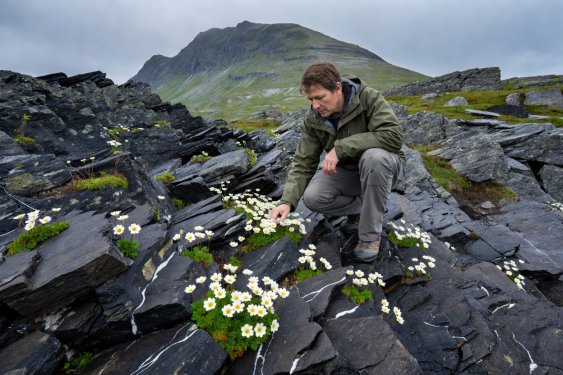
Hiker crouching beside blooming white Mountain Avens flowers growing on dark calcareous schist ledges in Dovrefjell
Botanical Geology

How Flowers Reveal Bedrock Chemistry

You can often identify bedrock without hitting it with a hammer simply by noting what blooms in the scree. Acidic quartzites and granites in Rondane support sparse, hardy species: Highland Rush, Crowberry, and yellow-green map lichens. Cross onto the calcareous phyllites and greenstones of Knutshøe on Dovrefjell or inner Troms, and the turf erupts with eight-petalled white Mountain Avens (Dryas octopetala), Purple Saxifrage (Saxifraga oppositifolia), and rare alpine gentians.

Snow Cover Gradient

The Ridge-to-Hollow Microclimate

In winter, strong mountain winds sweep snow off convex ridges (rabbe) and pack it meters deep into concave leeward hollows (snøleie). This creates a sharp ecological sequence over a horizontal distance of less than twenty metres:

1. Exposed Ridge Crest: Snow-free all winter. Plants must endure severe frost and dehydrating winds, but they start photosynthesising in May. Only woody prostrate mats like Trailing Azalea and Diapensia survive here.

2. Leeward Heath Slope: Protected by 50–150 cm of insulating winter snow (which keeps ground temperatures near -1°C to -3°C) yet melts out by early June. Ideal for Bilberry, Blue Heath (Phyllodoce caerulea), and Dwarf Birch.

3. Late Snowbed: Buried under snow until late July. Plants here avoid winter frost entirely, but must complete leafing, flowering, and seed set in just five weeks. Look for tiny Dwarf Willow (Salix herbacea) and Starry Saxifrage.
Field Etiquette & Fauna

Observing High-Mountain Wildlife Without Disturbance

Norway’s alpine plateaus—particularly Hardangervidda, Snøhetta, Rondane, and Reinheimen—hold the last wild mountain reindeer (villrein) herds in Europe. Because high-altitude life operates on tight energy margins, attentive walkers adjust their pace and distance.

  • Wild Mountain Reindeer (Rangifer tarandus tarandus) Reindeer rely on wind direction to scent predators and move constantly into the breeze while grazing on slow-growing lichens. If you spot a herd on a distant snow patch (where they gather on warm days to escape warble flies), stop immediately, sit down to break your silhouette, and detour downwind or wait until the animals move away calmly.
  • Rock Ptarmigan (Lagopus muta) Above the low-alpine willow belt, listen for a dry, croaking rattle among granite boulders. Ptarmigan moult three times a year to match the changing ratio of snow and grey lichen-covered rock, trusting their camouflage until a walker is within a few steps.
  • Arctic Fox (Vulpes lagopus) & Norwegian Lemming The breeding success of endangered Arctic foxes on Dovrefjell and Finse is tightly coupled to the three-to-four-year population cycles of the Norwegian Lemming (Lemmus lemmus). Never approach grassy gravel mounds (old den sites) on low-alpine moraine ridges.