Sand Summit Fieldbook — Chapter 04: High-Latitude Optics, Light & Composition
Chapter 04 • Observation-Led Landscape Photography

Photographing form through changing light

When you understand how a cirque was excavated or why a moraine curves across a valley floor, composition stops being an exercise in visual decoration. Your camera becomes a notebook for recording how directional light clarifies mountain processes.

High-Latitude Solar Geometry

Why Norwegian Light Lingers on Vertical Relief

In equatorial or mid-latitude mountains, sunrise and sunset happen almost vertically—the sun climbs rapidly out of the golden hour within thirty minutes. In Norway, situated between 58°N and 71°N, the sun’s path intersects the horizon at a shallow oblique angle.

During June and July, twilight merges into dawn across Jotunheimen and Lofoten, giving photographers three to four hours of grazing side-light. In September and October, when Dwarf Birch and Bilberry turn deep copper and crimson across Rondane and Dovrefjell, even midday sun stays low enough (under 28° elevation) to model the three-dimensional relief of north-south glacial troughs.

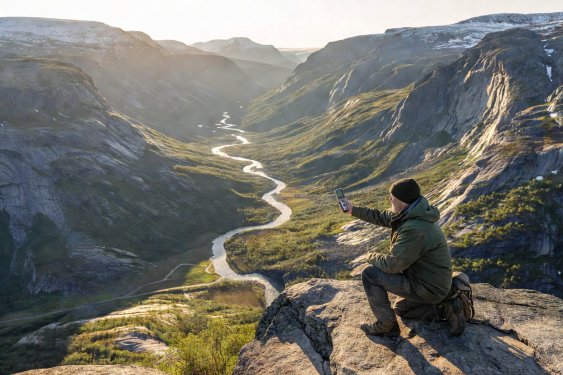
Before unpacking a tripod, watch how shadow edges travel across a rock wall. Cross-lighting at a 15- to 30-degree angle to the rock face separates overlapping ridge planes and makes subtle glacial striations or thrust-fault ledges immediately legible.

Nature photographer on a rocky ledge in Sunnmøre observing low-angle sunlight illuminating a U-shaped glacial valley
Field Discipline

Look Without the Viewfinder First

Spend your first fifteen minutes at a viewpoint with the camera still in your pack. Identify the primary geological lines—where the ice came from, where the rock bedding dips, and where wind shapes the vegetation—then choose the focal length that isolates that relationship.
Field Checklist

Photographer’s Observation List for Mountain Terrain

Rather than relying on ultra-wide lenses that shrink distant peaks into tiny bumps on the horizon, match your optical choices to the specific physical feature in front of you.

  • 1. Telephoto Compression (70–200 mm) for Structural Walls & Icefalls Stand on the opposite side of a glacial valley and use a medium telephoto lens to isolate the contact between a plateau ice cap and dark gneiss bedrock, or to show the rhythm of recessional moraine ridges without perspective distortion.
  • 2. Wet Bedrock & Lichen Colour Fidelity in Passing Rain Dry gabbro and gneiss scatter white sky reflections, washing out mineral contrast. Immediately after a rain squall or beneath low stratus cloud, rock surfaces darken by two exposure stops while green-yellow Rhizocarpon and orange Xanthoria lichens glow vividly. Use a circular polariser at partial rotation to manage wet rock glare without making the stone look unnatural.
  • 3. Metering for Snowbeds vs. Dark Gabbro High-mountain scenes in Norway often pair fresh white névé snow or glacial ice directly against dark, charcoal-coloured Jotun gabbro or wet phyllite—a dynamic range easily exceeding 11 stops. Expose to preserve micro-texture in the snow highlights (checking the red and green histogram channels separately) and let deep cliff shadows retain natural weight.
  • 4. Cloud Base as a Topographic Contour Line When low scudding clouds fill a valley up to 1,200 metres, the cloud deck acts like a horizontal water level, tracing the exact shape of cirque bowls and hanging valley thresholds.
Equipment & Cold-Weather Care

Practical Preparation for Wet & Windy Ridges

Stability in Wind

Low-Centre Tripod Stance

On exposed passes like Sognefjellet or Valdresflye, avoid extending a tripod’s centre column. Spread the legs one notch wider, hang your pack low beneath the apex so it touches the heather to dampen harmonic vibration, and shield the lens barrel with your body during exposure.

Condensation Control

Entering Warm Mountain Huts

When stepping into a heated DNT cabin after hours in freezing sleet or sub-zero autumn wind, leave your camera zipped inside your unheated pack for 45 minutes. Allowing the glass and metal chassis to warm gradually prevents internal moisture from fogging optical elements.

Lens Care in Spindrift

Dry Brush Before Microfibre

Glacial valleys carry fine airborne silt (loess and rock flour). Never wipe a dry microfibre cloth directly across a dusty lens element; use an air blower and a soft camel-hair brush first so quartz silt grains do not scratch the front coating.